Tashichho Dzong, ‘Fortress of the Glorious Religion’ or ‘Fortress of Auspicious Doctrine’, or popularly known as Thimphu Dzong, is an impressive structure that houses the throne room and offices of the king, the secretariat and the ministries of home affairs and finance. Other government offices are housed in the buildings nearby Tashichho Dzong. It’s been the seat of the Royal Government of Bhutan since 1962 after the capital moved to Thimphu from Punakha.
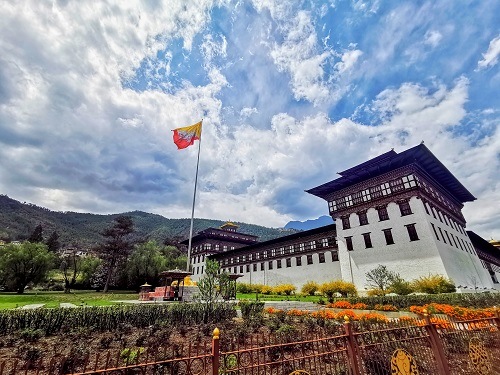
The dzong is located close to Thimphu town, on the right side, next to the banks of Wang Chhu River. It’s a huge majestic structure surrounded by beautiful gardens and well-kept lawns. There are thirty temples, chapels and shrines within Tashichho Dzong.
Tashichho Dzong was first constructed in 1216 A.D. by Lama Gyalwa Lhanangpa where Dechen Phodrang now stands above Thimphu. The dzong was originally known as Dho-Ngon (Blue Stone) Dzong. However, after Zhabdrung Ngawang Namgyal took over the dzong in 1961, he found it too small, and rebuilt another one, known as the lower dzong. Zhabdrung Ngawang Namgyal reconsecrated and renamed the dzong to Tashichho Dzong. Most of the original dzong was destroyed by fire in 1771 and a new dzong was built at the present site by the sixteenth desi, Sonam Lhurup, and consecrated by the thirteenth Je Khenpo (chief abbot), Je Yonten Taye. The dzong was destroyed by fire and rebuilt multiple times.
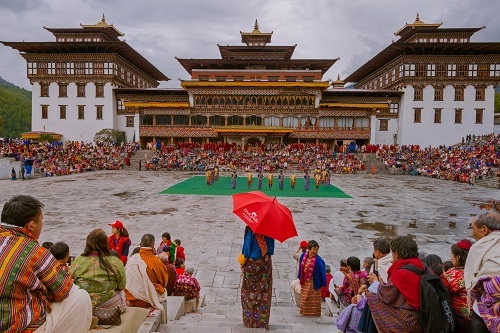
The present dzong was rebuilt by the third king, Jigme Dorji Wangchuck, in 1962 after the capital moved from Punakha to Thimphu. The entire architecture of the dzong was rebuilt in the traditional manner without any nails. Zopen Parpa Yodsel oversaw the overall renovation works. Only the utse (central tower), Lhakhang Sarp (new temple), and main goenkhang (protector temple) remained from the earlier dzong.
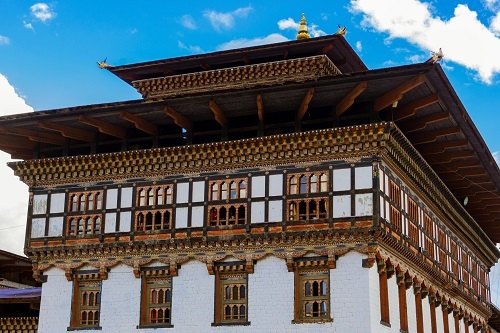
To the west of the dzong is a small tower, Ney Khang Lhakhang which houses a statue of Sakyamuni Buddha and other protective deities. In 1953, the royal family took up residence in the Dechencholing Palace, located in the north of Tashichho Dzong.
The popular annual 3-day Thimphu Tshechu festival is also held in Tashichho Dzong, in September.
Tashichho Dzong replica in Kagawa, Shikoku, Japan
You can also find a replica of the original Tashichho Dzong located in Kagawa, Shikoku in Japan. The replica is in Maragume, surrounded by the Ayauta Forest, at the edge of the New Reoma World complex. Inside, you can find Bhutanese artifacts and information about the Kingdom.
Check out the Tashichho Dzong replica in Kagawa, Japan.