 Druk Asia
Bhutan Dos and Don’ts: Etiquette, Dress Code & Travel Rules
Bhutan is a welcoming country, and visitors are not expected to know every local custom before arriving.
A little awareness, however, makes a big difference.
Bhutanese culture is closely connected with Buddhism, community values and respect for sacred spaces. Many of the monasteries, temples and dzongs you visit are not simply tourist attractions. They remain active places of worship and important parts of everyday Bhutanese life.
The good news is that Bhutan etiquette is generally easy to follow.
Dress modestly at religious sites, listen to your guide, ask before photographing people and treat sacred places with the same respect you would expect visitors to show at an important religious site in your own country.
Here are the most important dos and don'ts to know before travelling to Bhutan.
Table of Contents
What You Should Avoid Doing in Bhutan
Bhutan Temple and Monastery Etiquette
What Should You Wear in Bhutan?
Prayer Wheels, Chortens and Sacred Spaces
Can You Bring a Drone to Bhutan?
Bhutan Etiquette at a Glance
If you remember only a few things during your trip, remember these.
| Do | Avoid |
| Dress modestly at temples, monasteries and dzongs | Wearing revealing clothing at sacred sites |
| Remove hats at sacred places | Keeping caps or hats on inside temples |
| Follow your guide's instructions | Entering restricted rooms or areas |
| Walk clockwise around chortens and prayer wheels | Walking around sacred monuments in the wrong direction |
| Ask before photographing people | Taking intrusive photographs without permission |
| Speak quietly inside religious sites | Talking loudly or interrupting worship |
| Remove your shoes where requested | Walking into temple interiors with shoes on |
| Treat religious objects respectfully | Touching statues, murals or ritual objects |
| Keep Bhutan clean | Littering or damaging the natural environment |
| Ask when unsure | Assuming every site follows exactly the same rules |
What You Should Do in Bhutan
1. Dress Modestly at Religious Sites
When visiting temples, monasteries and dzongs, wear clothing that covers your shoulders and legs.
Long trousers, longer skirts and tops with sleeves are sensible choices.
Bhutan's official tourism guidance recommends long sleeves and covered legs when visiting temples.
You do not need to dress formally throughout your entire holiday. Casual clothes are perfectly suitable for road journeys, hiking and everyday sightseeing.
The important thing is to have appropriate clothing ready for sacred sites.
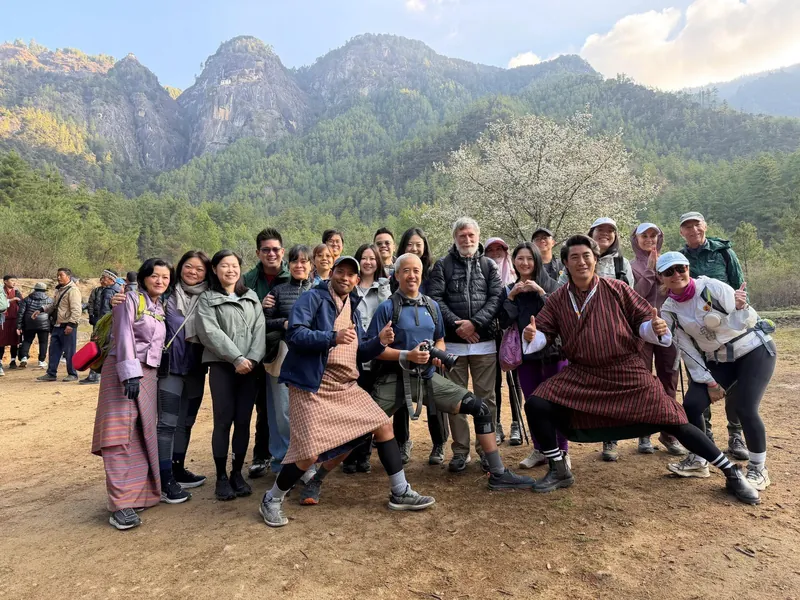
2. Remove Your Hat at Sacred Sites
Take off hats and caps when entering sacred areas.
This is also considered respectful when meeting elders, monks or nuns in more formal situations. Bhutan's official visitor guidance specifically recommends removing caps and hats at sacred sites and when meeting elders.
3. Follow Your Guide's Lead
Your Bhutanese guide is one of your best sources of cultural advice.
Rules can vary between temples, monasteries, dzongs, festivals and ceremonies.
Some rooms may be restricted. Photography may be allowed in one courtyard but not inside another building. A site may temporarily close for prayers or official functions.
If you are unsure, ask before entering, photographing or touching anything.
4. Walk Clockwise Around Sacred Objects
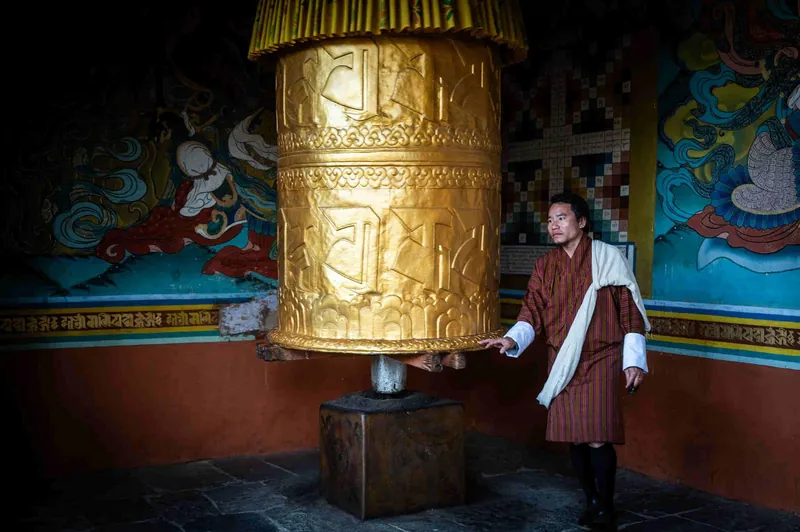
When walking around a chorten, stupa or other sacred Buddhist structure, move clockwise.
The same principle generally applies to rows of prayer wheels.
Keeping the sacred object on your right side is a simple way to follow local Buddhist practice.
5. Keep Your Voice Down in Temples
Many monasteries and temples are active places of prayer.
Speak quietly and avoid loud conversations, phone calls or disruptive behaviour.
Maintain silence at sacred sites so worshippers can practise peacefully.
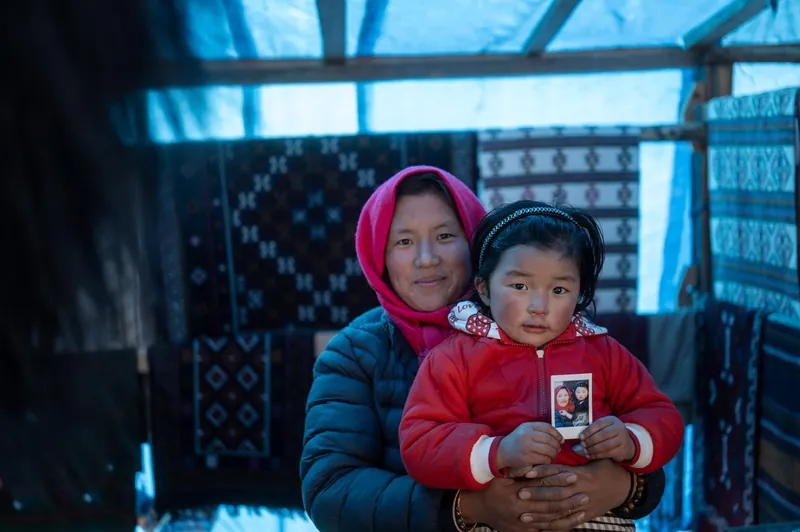
6. Ask Before Photographing People
Bhutan is incredibly photogenic, but local people should never feel like part of the scenery.
Ask before taking close photographs of individuals, particularly monks, elderly people and children.
Respect locals' privacy and obtain permission before taking photographs.
7. Try Local Food and Customs
Travel becomes much more meaningful when you participate.
Try ema datshi, momos and Bhutanese red rice. Taste suja at least once. Visit a local market. Learn a few Dzongkha phrases. Try archery if the opportunity arises.
You do not need to enjoy everything, but showing curiosity and respect goes a long way.
Read our guide to Bhutanese food if you want to know what to try.
8. Learn a Couple of Local Phrases
You do not need to speak Dzongkha to travel comfortably in Bhutan, but a couple of phrases are always appreciated.
Kuzuzangpo la means hello.
Kadrinchey la means thank you.
Check out our guide to Bhutanese language.
9. Respect Bhutan's Natural Environment
Bhutan's landscapes are an important part of the country's identity.
Take your rubbish with you, stay on established trails and avoid disturbing wildlife or removing plants.
Visitors should leave the natural environment as they find it.
What You Should Avoid Doing in Bhutan
1. Do Not Touch Religious Objects Without Permission
Avoid touching statues, paintings, ritual objects, altars or other religious items inside temples and monasteries.
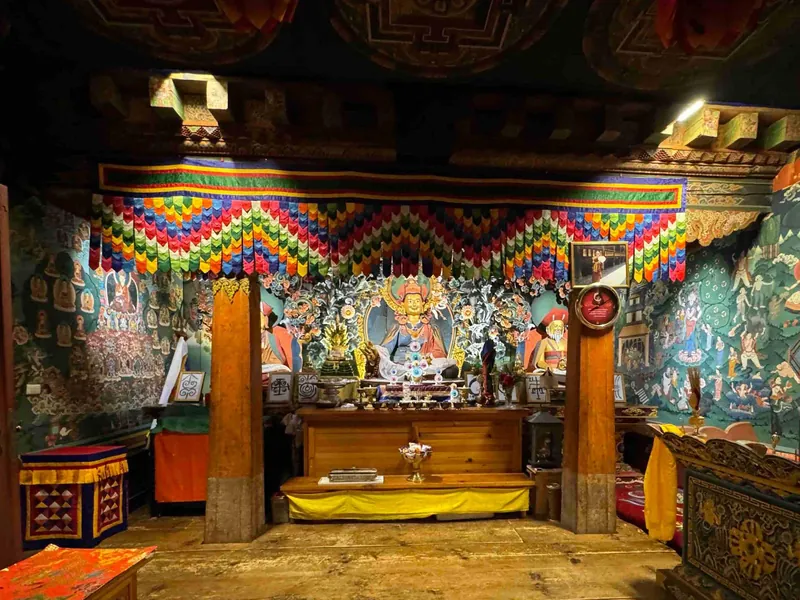
Even if something appears decorative, it may have religious significance.
2. Do Not Sit or Climb on Sacred Structures
Chortens, prayer walls and religious monuments are not photo props.
Do not sit on them, climb onto them or place bags and belongings on top.
You should also avoid sitting on the raised seats reserved for lamas inside temples.
3. Do Not Point Your Feet Towards Altars or People
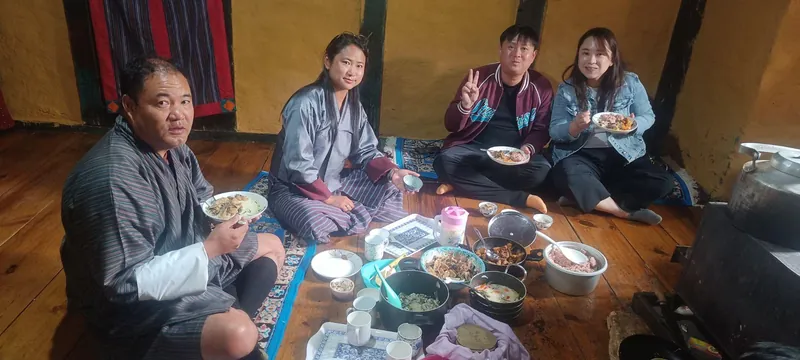
If you are sitting on the floor, avoid stretching your legs towards an altar, monk, elder or another person.
Sitting cross legged is usually the safest option especially when seated with monks, nuns, elders or hosts.
4. Do Not Photograph Inside Temples Unless It Is Clearly Allowed
Do not assume photography is permitted simply because someone else has taken out a phone.
Visitors should not photograph inside sacred sites.
Restrictions can vary, so follow signs and your guide's instructions.
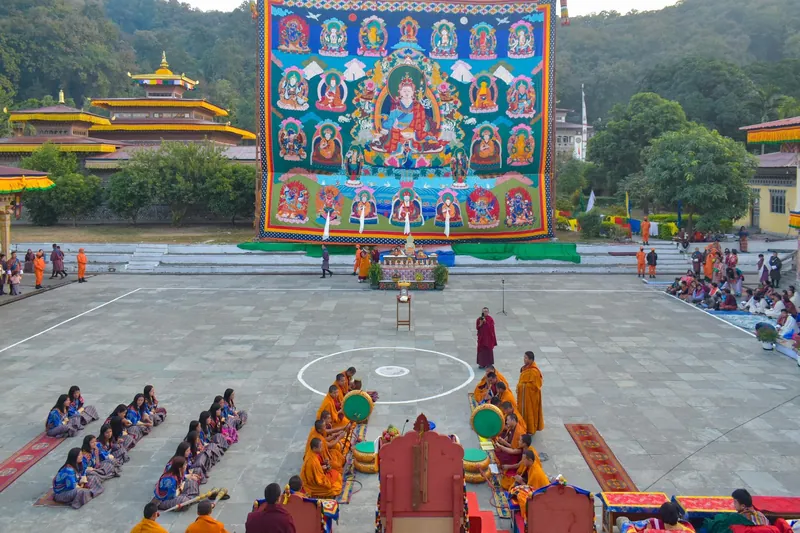
5. Do Not Interrupt Religious Ceremonies
If monks are praying or people are performing religious rituals, give them space.
Do not stand between worshippers and an altar, block processions or position yourself directly in front of someone just to get a photograph.
Avoid obstructing people practising their faith.
6. Do Not Give Money or Sweets to Children Randomly
Giving things directly to children can unintentionally encourage begging.
If you would like to support a school, monastery or community, speak with your guide or tour operator about a more appropriate way to contribute.
7. Do Not Litter
Do not leave food wrappers, tissues, plastic bottles or other rubbish behind on hiking trails, viewpoints or religious sites.
Carry waste with you until you find an appropriate bin.
8. Do Not Assume Every Area Is Open to Visitors
Parts of dzongs, temples and government buildings can be restricted.
Some locations may also temporarily close during religious ceremonies or official events.
Do not cross barriers or enter closed rooms without permission.
Bhutan Temple and Monastery Etiquette
Visiting Bhutan's monasteries is often one of the highlights of a trip.
Tiger's Nest, Kyichu Lhakhang, Chimi Lhakhang and the sacred temples of Bumthang remain active religious spaces.
Before entering a temple:
- Cover your shoulders and legs.
- Remove your hat.
- Remove your shoes where instructed.
- Keep your phone on silent.
- Ask before taking photographs.
- Keep conversations quiet.
- Do not touch statues or paintings.
- Do not sit on raised religious seats.
- Follow your guide when moving through the building.
Bhutan's official tourism guidance also notes that shoes are usually removed before entering temple interiors.
What Should You Wear in Bhutan?
Tourists do not need to wear Bhutanese national dress.
Comfortable travel clothes are suitable for most sightseeing.
The main consideration is visiting religious sites.
What to Wear at Temples, Dzongs and Monasteries
Choose:
- Long trousers or a long skirt
- Tops covering the shoulders
- Sleeves
- Shoes that are easy to remove
Avoid:
- Very short shorts
- Mini skirts
- Sleeveless tops
- Very low cut clothing
- Clothing with offensive slogans or imagery
Bhutan's official FAQ says there is no general visitor dress code, but respectful clothing covering the body from shoulders to knees is appropriate at religious sites.
Photography Rules in Bhutan
Photography is generally straightforward outdoors, and Bhutan offers exceptional opportunities for landscapes, architecture and cultural photography.
Religious interiors require more care.
You can generally photograph
Outdoor landscapes, streets, villages, viewpoints and many exteriors, subject to local restrictions.
Ask before photographing
People, monks, nuns, children, private homes and people participating in religious ceremonies.
Do not photograph
Inside sacred areas where photography is prohibited.
Restrictions vary from site to site, so always follow your guide's advice.
Prayer Wheels, Chortens and Sacred Spaces
You will encounter prayer wheels throughout Bhutan.
If you would like to turn them, move in the customary clockwise direction and rotate them gently as you pass.
Do not spin them aggressively or treat them as toys.
The same clockwise direction generally applies when walking around chortens and stupas.
Visiting Bhutanese Homes
A farmhouse or home visit can be one of the most memorable experiences of a Bhutan trip.
Wait for your host or guide to show you where to sit and what to do.
It is customary to remove shoes before entering many Bhutanese homes.
If food or tea is offered, accepting at least a little is a nice gesture if your dietary requirements allow.
There is no need to worry about mastering every cultural rule. Observe your host and follow your guide.
Tipping in Bhutan
Tipping is not compulsory in Bhutan.
It is entirely a personal gesture if you feel your guide, driver or other staff have taken particularly good care of you.
Druk Asia's current travel guidance confirms that tipping is voluntary rather than obligatory.
If you wish to tip your guide or driver, the end of your journey is usually the simplest time to do so.
Smoking and Tobacco Rules in Bhutan
Bhutan has strict rules on smoking in public places.
The current Druk Asia page says smoking is "restricted and sometimes banned", which is too vague.
Travellers who smoke should ask their hotel or guide where smoking is permitted rather than assuming any outdoor area is acceptable.
Can You Bring a Drone to Bhutan?
For an ordinary tourist, the practical answer is generally no unless prior permission has been obtained.
Bhutan's official tourism FAQ states that tourists are generally not permitted to bring drones into the country. A permit must be obtained in advance for authorised recreational or commercial operation.
Do not pack a drone assuming permission can be arranged after arrival.
If aerial filming is an important part of an official project, arrange the necessary approvals well before your trip.
Etiquette at Bhutan Festivals
Attending a tshechu can be one of the most memorable cultural experiences in Bhutan.
These festivals are religious gatherings as well as colourful public events.
Do
- Dress respectfully.
- Follow your guide's advice.
- Allow local worshippers room to participate.
- Ask before photographing people closely.
- Keep entrances and walkways clear.
- Watch sacred dances without interrupting performers.
Avoid
- Standing directly in front of seated spectators.
- Entering the performance space.
- Blocking worshippers for photographs.
- Using intrusive photography around religious rituals.
If you are planning your trip around a festival, check our Bhutan festival calendar.
Environmental Etiquette in Bhutan
Many travellers come to Bhutan specifically for its forests, mountains and valleys.
Help keep them that way.
Avoid unnecessary waste, use refillable water bottles where safe refill arrangements are available and carry rubbish out of hiking areas.
Do not pick plants or disturb wildlife.
Stay on established trails unless your guide advises otherwise.
Bhutan's official guidance also recommends using an accredited guide when venturing into wild areas.
Common Mistakes First Time Visitors Make
Treating temples like ordinary tourist attractions
The architecture may be spectacular, but people are actively praying inside.
Wearing shorts on a sightseeing day
A normal sightseeing route can easily include a monastery or dzong. Keep suitable clothing available.
Taking photographs before asking
This is especially common at markets, festivals and villages.
Assuming every temple allows photography
Many sacred interiors do not.
Packing a drone
Tourists are generally not permitted to bring drones into Bhutan without advance approval.
Worrying too much about making a mistake
Bhutanese people are accustomed to welcoming international visitors.
Nobody expects you to arrive knowing every detail of local etiquette. Be respectful, watch what people around you are doing and ask your guide when unsure.
Frequently Asked Questions About Bhutan Etiquette
What should tourists not do in Bhutan?
Visitors should avoid disrespecting religious sites, touching sacred objects, photographing prohibited temple interiors, climbing on religious monuments, littering and entering restricted areas.
You should also ask before taking close photographs of people.
What is considered disrespectful in Bhutan?
Disrespectful behaviour can include wearinginappropriate clothing inside religious sites, speaking loudly during prayers, pointing your feet towards an altar, touching sacred objects or interrupting ceremonies.
Most mistakes can easily be avoided by following your guide.
Can tourists wear shorts in Bhutan?
Yes, shorts can be worn in suitable casual settings.
However, they are generally not appropriate for temples, monasteries and dzongs. Wear clothing that covers your legs and shoulders for religious sightseeing.
Do tourists have to wear traditional Bhutanese clothing?
No. Visitors are not required to wear a gho or kira.
Normal comfortable travel clothing is suitable as long as you dress respectfully when entering religious or formal places.
Can you take photographs in Bhutanese temples?
Photography is commonly restricted inside sacred sites.
Follow your guide, site signage and local instructions.
Can you photograph monks in Bhutan?
Ask before taking close photographs of monks or nuns.
This is particularly important during prayer, rituals or ceremonies.
Do you have to remove your shoes in Bhutanese temples?
Shoes are usually removed before entering temple interiors and other sacred areas where indicated.
Is tipping compulsory in Bhutan?
No. Tipping is voluntary and entirely at your discretion.
Can tourists smoke in Bhutan?
Smoking is regulated, especially in public places.
Ask your guide or accommodation where smoking is permitted rather than smoking in public or near religious sites.
Can tourists bring drones into Bhutan?
Tourists are generally not permitted to bring drones into Bhutan without prior approval.
Any permitted operation requires advance authorisation.
Do tourists need to know Dzongkha?
No. English is widely used within Bhutan's tourism industry, and your guide can help with communication.
Learning simple phrases such as Kuzuzangpo la and Kadrinchey la is still a nice gesture.
Travel Bhutan With Respect and Curiosity
You do not need a long rulebook to travel respectfully in Bhutan.
Dress appropriately at sacred sites, give people space to practise their faith, ask before taking photographs and follow the advice of your guide.
Most importantly, approach Bhutan with curiosity rather than worrying about getting every custom exactly right.
Some of the best moments of a Bhutan journey happen when you slow down, ask questions and understand why a tradition matters instead of simply taking a photograph.
If you are planning your first trip, explore our Bhutan tour packages or speak with our Bhutan Travel Specialists about building an itinerary around the places and experiences that interest you most.
Ready to Experience Bhutan?
Talk to our Bhutan specialists — we've helped over 22,940+ travellers plan their perfect trip.
