If you’ve ever wanted to witness devotion expressed grain by grain, sand mandala art in Bhutan is one of the most profound cultural experiences you can encounter in the Himalayas. Known locally as Dul-Tson Kyil Khor, meaning “Mandala of Coloured Powders”, this sacred art form is far more than an intricate design. It is meditation in motion, ritual in colour, and a powerful teaching on impermanence.
In Bhutan’s Vajrayana Buddhist tradition, creating a sand mandala is both a spiritual practice and a ceremonial offering — one that leaves a lasting imprint on the heart long after the final grain has been swept away.
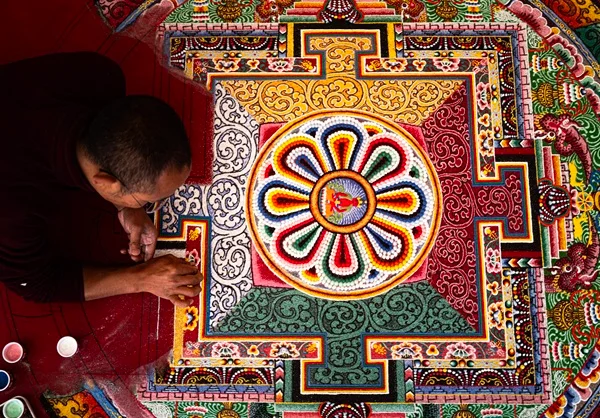
What Is a Sand Mandala (Dul-Tson Kyil Khor)?
A sand mandala is a sacred geometric diagram created using finely ground coloured powders, traditionally made from crushed minerals and natural pigments.
In Bhutanese Buddhism, mandalas represent the cosmic palace of a deity — a symbolic map of the enlightened universe. Every line, petal, flame, and gateway has meaning. Nothing is random.
When monks create a Dul-Tson Kyil Khor, they are not simply producing artwork. They are:
Performing a ritual practice
Reciting mantras
Visualising sacred realms
Training the mind in concentration and compassion
It is art as meditation — precise, patient, and deeply intentional.
The Significance of Sand Mandalas in Bhutan
Bhutan is renowned for its sacred arts, from thangka painting to intricate wood carvings. Yet sand mandalas feel uniquely intimate because you witness the entire journey of creation and dissolution.
Sand mandalas are typically created for:
Blessings and protection
Healing ceremonies
Spiritual empowerment rituals
Temple anniversaries and sacred events
Special religious festivals
What makes them especially powerful is this: once completed, they are ceremonially dismantled.
This act embodies the Buddhist teaching of impermanence — reminding us that even the most beautiful creations are temporary.
The Creation Process: Grain by Grain
Watching a sand mandala take shape is mesmerising. Here is how the process typically unfolds:
1. Ritual Preparation
Before any sand is placed, monks consecrate the space with prayers, offerings, and chanting. The mandala is established as a sacred act, not a decorative display.
2. Drawing the Geometric Blueprint
Using precise measurements, monks map out an exact geometric grid. The symmetry and balance you see later begin with mathematical accuracy.
3. Placing the Coloured Sand
Using special metal funnels called chak-pur, monks gently tap coloured sand into place. The sand flows in controlled streams, building intricate patterns from the centre outward.
The atmosphere is quiet. Focused. Almost hypnotic.
4. Completion and Blessing
Final details — flames, lotus petals, deities, and sacred symbols — are added. Prayers seal the mandala’s spiritual intention.
5. The Dissolution Ceremony
Perhaps the most moving moment of all.
The mandala is swept away in a ritual gesture. Some of the sand may be distributed as blessings, while the rest is traditionally released into flowing water, symbolising the spreading of compassion to all beings.
You may also create your own sand mandala to take home as a keepsake.
Understanding the Symbolism of Sand Mandala Art
While mandalas are highly detailed, you can appreciate them through a few key elements:
The Centre – Represents enlightenment or the main deity
The Four Directions – Symbolise balance and wholeness
Lotus Motifs – Purity and spiritual awakening
Gates – The transition from ordinary perception to awakened awareness
Colours – Correspond to elements, directions, and enlightened qualities
Each mandala is a sacred universe rendered in colour and geometry.
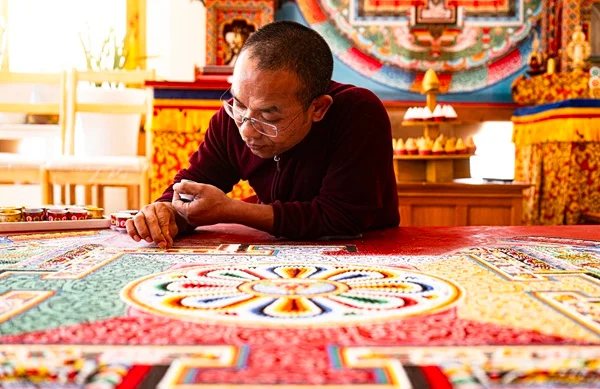
Where You May Experience a Sand Mandala in Bhutan
The Sand Mandala Display Center — the only one of its kind in Paro — is located near Namizampa, conveniently situated on the road leading into town.
Joining a Guided Mandala Workshop
Some cultural centres and mindfulness experiences offer educational sand mandala sessions inspired by the tradition. These workshops allow you to:
While simplified, these sessions can be deeply calming and meaningful when conducted respectfully.
Etiquette: Watching with Respect
When observing a sand mandala in Bhutan, remember:
Speak softly
Ask before photographing
Do not touch the mandala or tools
Follow your guide’s instructions
Maintain reverence during the dissolution ceremony
Sacred spaces in Bhutan are welcoming, but always approached with humility.
Why the Dissolution Feels So Powerful
Seeing efforts of intricate work gently swept away can stir unexpected emotion. Yet in Bhutan, this is not loss — it is wisdom.
The dissolution reminds us:
Beauty does not need permanence to have meaning
Letting go is part of the spiritual path
Attachment is softened through understanding impermanence
It is a quiet, profound teaching delivered without a single word.
A Sacred Experience You Carry Home
Taking part in or witnessing the creation of a Dul-Tson Kyil Khor is not simply a cultural activity. It is an invitation to slow down, focus deeply, and reflect on life’s fleeting nature.
In Bhutan, beauty is created with devotion — and released with grace.
A sand mandala is not meant to last.
But the lesson it leaves behind always does.